Tangent Graphs
Tangents graphs g uphill while cotangent graphs go downhill. the reason being is because of their asymptotes. these you can get by your unit circle. the ratio for tangent is y/x and when x=0 we get an asymptote and when that happens is when it is at 90 and 270 degrees which convert to pi/2 and 3pi/3 so knowing this we know that the graph cant touch it but what also has the affect s the quadrants in a unit circle we know that tangent is positive in the 1 and in the 3rd and negative in the 2 and 4th so this shows you were the part of the graph is going to be above or below the x axis
The same goes to cotangent. its ratios are x/y so this time y has to = 0 and when it does it is at the 0 and 180 degree and the asymptotes for that is pi and 2pi even though that have the same four quadrants the asymptote are the ones that make this graph go downhill instead of uphill like tangent
Monday, April 21, 2014

BQ#3

Cotangent is on the bottom of the picture. here we know that cotangent is the opposite tangent so the ratio is x/y so now whenever y=0 there will be an asymptote. but if sine and cos are positive the graph is going down hill if its negative it goes up.

secant is on the top picture as you can see wherever cosine =0 there you can find secant it looks like a parabola because there are asymptotes
for cosecant It is the last picture as you can see it is the same as secant but you can find cosecant whever sine =0 and it too has asymptotes which give it its shape
Thursday, April 17, 2014
BQ#5
BQ#5
Sine and Cosine do not have asymptotes the reason being that sine and cosine will never have a denominator equal 0.when the denominator equals zero it means it is undefined and when it is undefined it will give u an asymptote. if we go back to the unit circle we know that sine and cos will always be over one so it can ever be over zero there for not having asymptotes. but tangent and the others do because they can be over zero.
Sine and Cosine do not have asymptotes the reason being that sine and cosine will never have a denominator equal 0.when the denominator equals zero it means it is undefined and when it is undefined it will give u an asymptote. if we go back to the unit circle we know that sine and cos will always be over one so it can ever be over zero there for not having asymptotes. but tangent and the others do because they can be over zero.
Wednesday, April 16, 2014
BQ #2 Unit T Intro
BQ#2
There is a period for sine and cosine that is 2pi, it is 2pi because it is one revolution of the unit circle, it is how much times it takes to repeat its cycle. When we use A,S,T,C on out graph we know that Sine is positive n quadrant 1 and 2 and will be negative on 3,4 . now for cosine it is positive on quadrant 1 and 4 but will be negative on 2 and 3 . as you can see it takes 4 to repeat the pattern which is why it takes 2pi but with tangent it only takes pi because it is positive negative then positive and negative again so it repeats after the second one.
the fact that it has amplitudes it makes sine and cosine have restrictions. the restriction are 1 and -1 with this restrictions they cant go past a certain paint un like tangent. if we try any number it wont work because of the restriction so its the same like the unit circle.
Friday, April 4, 2014
Reflection #1 unit Q Trig identities
- To verify is to prove an identity. you have to use logical steps and identities to show how you can make one side equal the other.
3. I usually just try to convert everything to sine and cos. I try to look at the problem as a whole and see if anything can cancel out or steps I can take to solve it. it takes me a while but after I know something isn't going to work and move on to try something else I can end up solving .
Wednesday, March 26, 2014
SP7: Unit Q Concept 2 IDENTITIES
This WPP13-14 was made in collaboration with Louis Troung. Please visit the other awesome posts on their blog by going here.


WE CAN FIND THE SAME THING USING SOHCAHTOAH 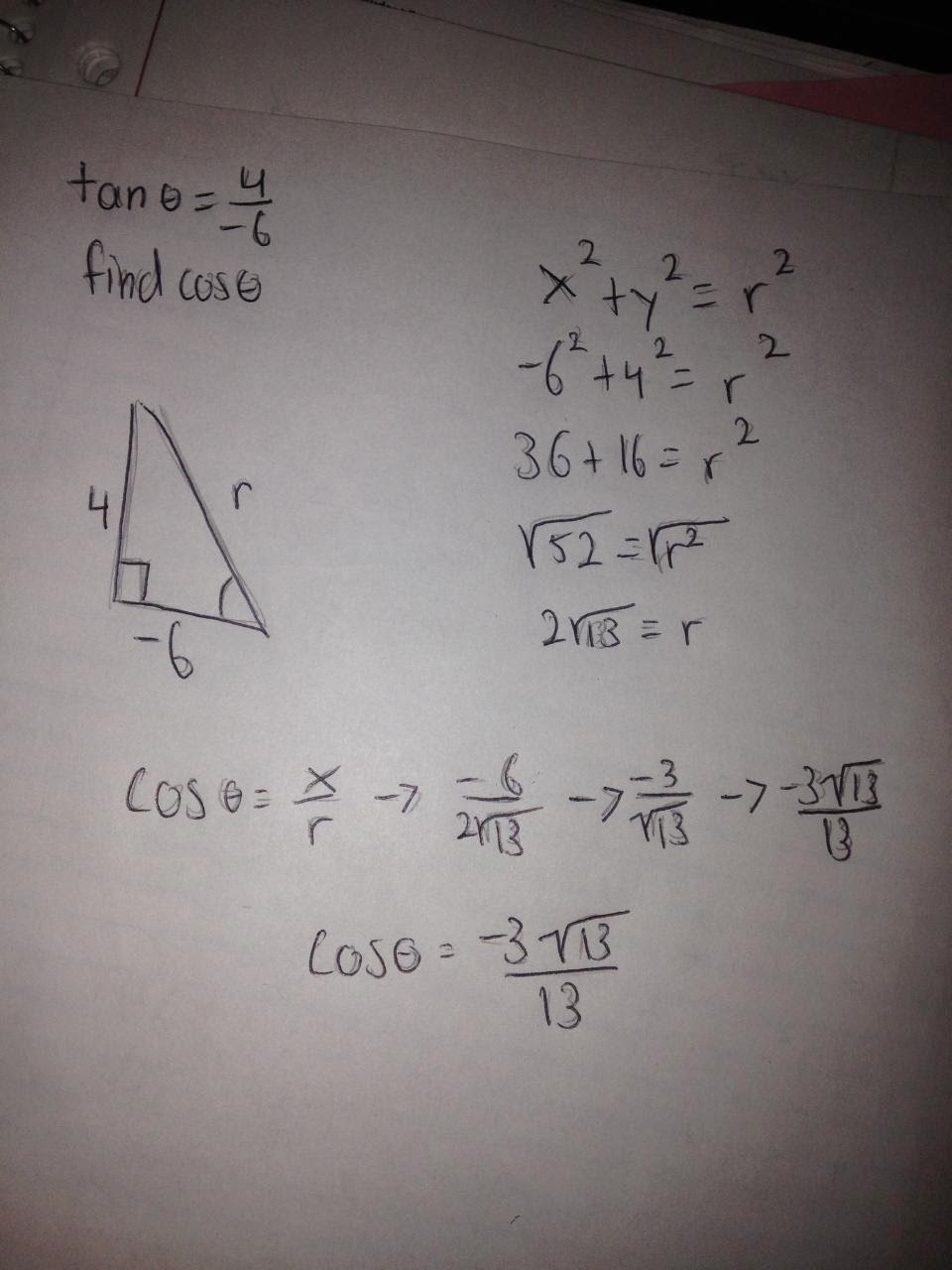
Wednesday, March 19, 2014
I/D#3: Unit Q Concept 1: Pythagorean Identities
INQUIRY ACTIVITY SUMMARY
Pythagorean identities come from the Unit Circle and the Pythagorean Theorem. An Identity is an equation that is true no matter what values are chosen. The Pythagorean Theorem kind of looks like an identity because even if you have 2 sides you can always find the 3rd using the theorem. The Pythagorean theorem is a^2+b^2=c^2 and the Pythagorean identity is cos^2(theta) + sin^2(theta) = 1. but on a unit circle it is x+y=1 we are going to substitute them so a is going to be x, y is b and 1 = r so 1 is c as you can see. r=1 because r is the radius of the circle and the radius of a unit circle is always going to be 1.


\what you can notice about how cosine =x and sine= y that it really does relate because the equation is cos^2(theta) + sin^2(theta) = 1 and you can see cos = x in the equation and sin=y and 1 =1. just like the Pythagorean theorem they are squares and like the unit circle they are x and y. and this is one of the identities.


1. the connection I have seen between Units N,O,P, and Q are that we can find angles on the unit circle and the sides and angles inside triangles that are missing using law of sines and cosines
2) If I had to describe trigonometry in THREE words, they will be hard, understandable, and progressive.
Subscribe to:
Posts (Atom)